Demon Lord Diablos
Rock Falls, Everyone DiesDemon Lord Diablos is the red-skinned villain at the center of the rolling stone’s first decisive intervention. Although the battle initially presents him as the opposing force in a conventional hero-versus-villain confrontation, his defeat is caused in part by an accidental strike from a pebble rather than by the hero’s attack alone. That collision gives the stone experience, a permanent enmity with demons, and its first clear proof that even an apparently insignificant object can alter the fate of a legendary conflict.
Identity and Introduction
Demon Lord Diablos is introduced during a battle on a mountaintop high above the clouds. The scene is framed in the language of a grand mythic duel: a hero and a villain face one another while trading extravagant attacks, including a holy sword and an aegis of divine darkness. Diablos therefore enters the story as an archetypal demon lord, a figure defined by opposition to a heroic champion and by the enormous stakes conventionally attached to such a title.
The evidence gives little personal history for Diablos, but it establishes his physical distinction and narrative function. He is red-skinned, visibly unlike the white-clad figure fighting him, and dangerous enough that the battle is treated as a major supernatural confrontation. His identity is less developed through biography than through the role he occupies in the story’s opening ritual: he is the first great enemy whose defeat converts the rolling stone from a passive traveler into an acknowledged participant in the world’s heroic system.
The Mountaintop Battle
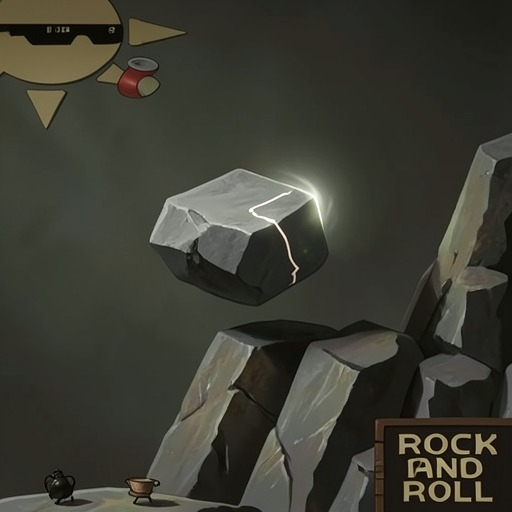
Diablos’s encounter with the pebble begins while the stone is flying through the air after discovering that movement makes its numbers increase. The pebble is not pursuing Diablos, seeking battle, or attempting to aid the hero. It notices only that its flight is ending because it is headed toward the head of a strange red-skinned creature engaged with a white-clad opponent. The impending collision is therefore accidental, but the story turns that accident into a causal hinge.
The pebble strikes Diablos in the face. The damage is minimal, yet the moment is tactically decisive: Diablos flinches, and the white-clad combatant uses that opening to drive a sword deep into his chest. The demon lord’s defeat consequently belongs to two forms of force at once. The hero supplies the finishing attack, while the stone supplies the interruption that makes the attack possible. A supposedly negligible impact becomes the intervention that changes the battle’s outcome.
The scene also establishes a recurring pattern in which the rolling stone enters conflicts without human intention but nevertheless becomes entangled in their consequences. Its physical properties are simple—flight, velocity, collision—yet the system interprets those properties as meaningful action. Diablos is the first major figure to demonstrate how the stone’s material existence can function as heroic agency.
Defeat and Prophecy
After being struck and stabbed, Diablos declares that the conflict is not truly over. He announces that he will resurrect in 666 years and that humanity will then be doomed. This statement transforms an apparent victory into a deferred threat. His death is not presented as the final removal of evil, but as one turn in a larger cycle governed by a precise interval and a promise of return.
The prophecy also gives Diablos a role beyond the immediate battle. He becomes a measure of the story’s interest in recurrence: a demon lord can be defeated, yet defeat does not necessarily end the danger associated with him. The threat is displaced into the future, where resurrection and human doom remain linked. The later repetition of mountaintop battle openings strengthens this cyclical design, making Diablos’s declaration feel like an early expression of a structure that will repeatedly return to heroic conflict.
The white-clad hero’s response is strikingly practical rather than mythic. The hero explains that the Isekai Office contracted him for only one demon lord and that his obligation ends there. This exchange undercuts Diablos’s apocalyptic rhetoric with bureaucratic limits. Diablos speaks in terms of resurrection and the fate of humanity; the hero speaks in terms of contract scope. Their conflict therefore joins cosmic stakes to institutional procedure, a combination that recurs throughout the story’s treatment of quests, rewards, and supernatural obligations.
Impact on the Rolling Stone
The system explicitly credits the pebble with assisting in the defeat of Demon Lord Diablos and grants it 500,000 assist experience. The reward confirms that the stone’s accidental collision has been recognized as participation rather than dismissed as incidental physics. The event is the first major conversion of motion into advancement: a flight that began merely because larger numbers were desirable ends with the stone gaining a substantial reward and a new place within the world’s hierarchy of action.
The stone also receives the title Enemy of Demons. Its effects are concrete: it deals 20 percent greater damage to demons, gains 20 percent more experience from killing demons, and acquires permanent hostility with all demons. Diablos’s defeat thus creates an enduring relationship between the stone and an entire enemy category. The encounter does not merely increase a statistic; it alters the stone’s future circumstances by making demonic hostility permanent and by making future demon-related encounters more rewarding and more dangerous.
This consequence is especially important because the stone does not begin with a conventional heroic objective. It is learning that growth follows whatever makes its numbers rise, and the battle teaches it that even unplanned participation can produce extraordinary advancement. Diablos becomes the first enemy through whom the stone experiences the logic of the quest system at full scale: action is quantified, assistance is rewarded, and an accidental act can generate a lasting identity.
Narrative Significance
Demon Lord Diablos is a relatively compressed character, but his narrative importance is extensive. He supplies the opening heroic conflict, the first large-scale enemy defeat, the first major experience reward, and the first permanent title imposed on the rolling stone. His red-skinned presence marks the boundary between the stone’s earlier wandering and its entry into a world of demons, heroes, contracts, and system-recognized accomplishments.
His promised resurrection also anticipates the book’s larger pattern of repeated beginnings and unfinished consequences. The story revisits the formula of a mountaintop confrontation in later chapter openings and epilogues, while the rolling stone’s own quest eventually reaches destruction, transfer, and genesis. In that larger structure, Diablos represents the initial version of the enemy who returns after apparent defeat. The demon lord is overcome, but the pattern he embodies is not: conflict, reward, recurrence, and another ascent toward a future confrontation remain built into the story’s design.